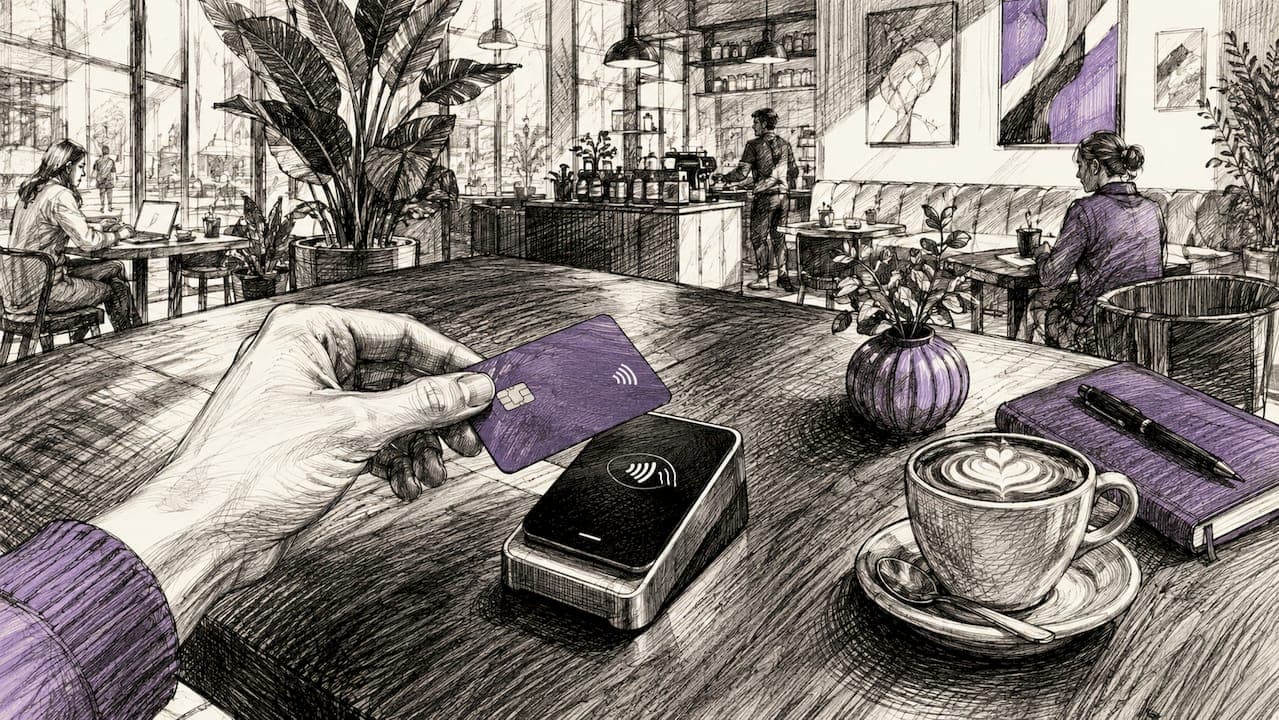
Contactless card technology is defined as a wireless payment and data-sharing method that uses Near Field Communication (NFC) to transfer information between a card and a reader without physical contact. The card simply taps or hovers near a compatible terminal, completing a transaction in 1–2 seconds. That speed is not a trade-off against security. Each transaction generates a unique, one-time cryptographic code under the EMV standard, making the data useless to anyone who intercepts it. Whether you are paying for a coffee, boarding a train, or sharing your professional details at a networking event, the same underlying NFC technology powers all of it.
What is contactless card technology and how does it work?
NFC is a subset of RFID (Radio Frequency Identification) and operates at 13.56 MHz. That frequency is an international standard, not a proprietary choice, which is why a card issued in London works on a terminal in Tokyo. The chip inside a contactless card communicates with the reader by broadcasting a tiny radio signal across a very short distance.
The card carries no battery. It draws power from the reader's electromagnetic field through a loop antenna embedded in the card body. The moment you bring the card close to a terminal, the field energises the chip and the transaction begins. Remove the card and the chip goes dormant again.
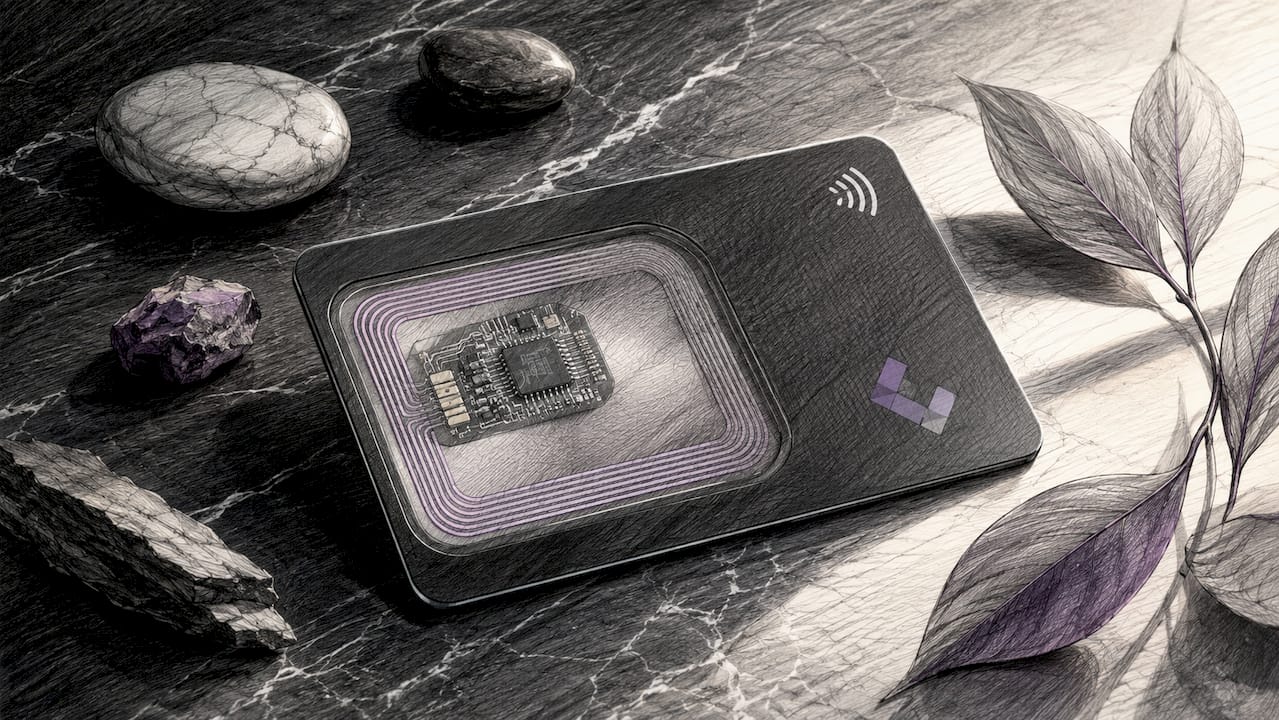
Communication only happens when the card is within 4 cm of the reader. That physical limit is a deliberate design choice. It means a card sitting in your pocket or bag cannot be read by a terminal a metre away.
What happens during a contactless transaction
The sequence is fast but precise. Here is what occurs in those 1–2 seconds:
- The reader broadcasts a radio frequency field at 13.56 MHz.
- The card's antenna harvests energy from that field and powers the chip.
- The chip and reader perform a mutual authentication handshake using EMV protocols.
- The chip generates a unique one-time cryptogram specific to that transaction.
- The cryptogram, along with tokenised card data, is sent to the reader.
- The issuing bank verifies the cryptogram and authorises or declines the transaction.
The key distinction from older magnetic stripe cards is that the data transmitted changes every single time. A magnetic stripe sends the same static number on every swipe. That static number can be copied and reused. A contactless cryptogram cannot.
Pro Tip: If a terminal prompts you to insert your chip card instead of tapping, the terminal may not support contactless. Both methods use EMV security, so neither option compromises your protection.
What security measures protect contactless card transactions?
The security architecture of contactless cards rests on three pillars: dynamic cryptograms, tokenisation, and physical proximity limits.
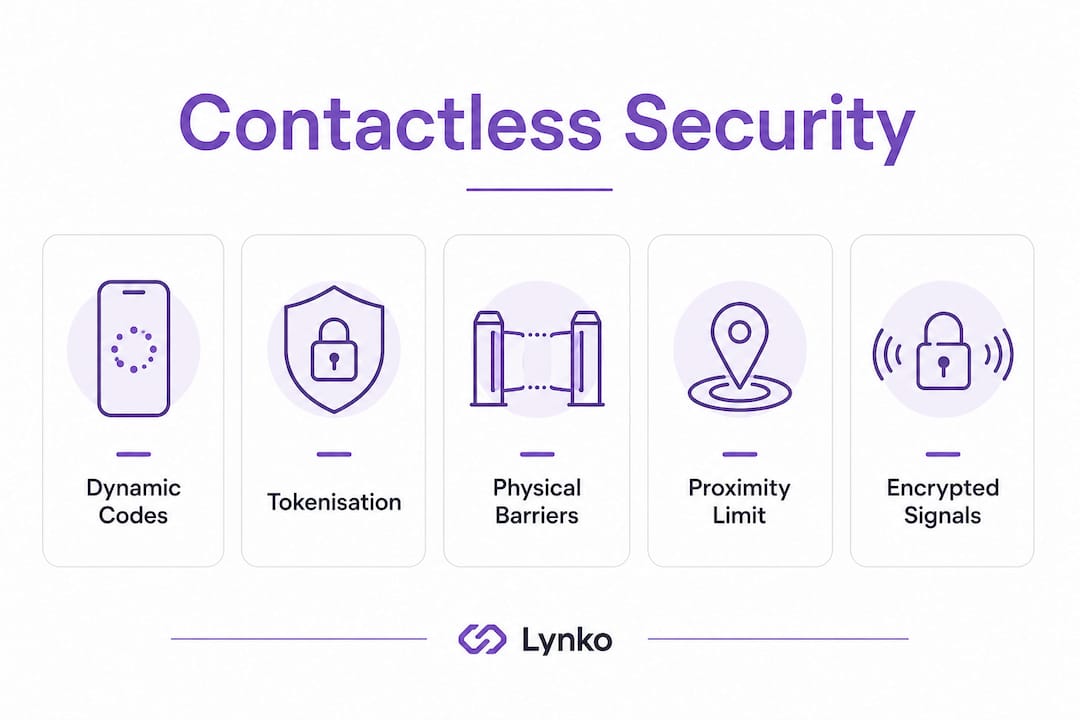
Every contactless transaction produces a dynamic code tied to that specific payment. Each transaction uses a unique cryptogram authenticated by the issuing bank, so intercepted data from one transaction cannot be replayed in another. This is fundamentally different from a magnetic stripe, where the static card number is the only credential.
Tokenisation adds a second layer. Actual card data is never transmitted to the merchant or terminal. Instead, a token, a surrogate value with no use outside that specific transaction, travels across the connection. Even if someone captured the token, it would be worthless for any future purchase.
The proximity requirement of 4 cm or less closes the gap that might otherwise allow opportunistic scanning. A fraudster would need to hold a reader directly against your card, in a crowded space, without you noticing. That is a far harder attack than copying a magnetic stripe from a skimmer attached to a cash machine.
Addressing the "no PIN" concern
A common worry is that small contactless payments require no PIN, which feels less secure. Security experts confirm this concern is unfounded. The dynamic cryptogram provides stronger authentication than a static PIN ever could. A PIN is a fixed secret that can be observed, guessed, or stolen. A cryptogram is mathematically unique to each transaction and verified by the bank's own systems.
The numbered steps below show how the security layers stack:
- The card generates a one-time cryptogram using its EMV chip.
- Tokenisation replaces real card data with a transaction-specific token.
- The 4 cm proximity limit prevents remote or accidental reads.
- The issuing bank performs real-time cryptogram verification before approval.
- An Application Transaction Counter increments with each use, so out-of-sequence transactions are automatically rejected.
Pro Tip: An RFID-blocking wallet adds a physical barrier against any theoretical scanning attempt in very crowded environments. It is a low-cost addition for those who prefer extra peace of mind.
What are the common uses of contactless card technology beyond payments?
Contactless technology is not limited to retail payments. Physical cards, smartphones, and wearables all use the same NFC standard, which means the same chip architecture powers a wide range of applications.
The table below maps the most common use cases to the device type and the underlying mechanism:
| Use case | Device type | Core mechanism |
|---|---|---|
| Retail payment | Card, phone, watch | EMV cryptogram + tokenisation |
| Public transport | Card, phone | Stored value or account-based ticketing |
| Building access control | Smart card, fob | Encrypted credential exchange |
| Digital business card | NFC card | Tap-to-share profile data |
| Hotel room key | Smart card | Encrypted room credential |
Each of these applications relies on the same 13.56 MHz NFC standard, which is why a single card can carry multiple functions. Dual-interface cards support both contact and contactless chip transactions, giving users flexibility when a terminal only accepts one method.
NFC business cards as a professional networking tool
The professional networking application deserves particular attention. A traditional paper business card is a static object. Once printed, the information on it cannot change. An NFC business card, by contrast, links to a live digital profile. Tap it against any smartphone and the recipient sees your current contact details, social links, and portfolio, with no app required.
Lynko builds on this principle with NFC business cards that connect to a fully customisable digital profile. Professionals can update their details in real time, track who has viewed their card, and include unlimited social links and Google review prompts. The benefits for professionals go well beyond convenience. A single tap replaces the entire exchange of paper cards, follow-up emails, and manual contact saving.
Tokenisation supports secure authentication in these non-payment contexts too. The NFC tap shares only what the profile owner chooses to share, and the underlying card data is never exposed to the recipient's device.
What are the benefits of contactless cards for individuals and professionals?
The practical advantages of contactless technology fall into four clear categories: speed, hygiene, security, and professional utility.
- Speed. Transactions complete in 1–2 seconds, compared to 10–30 seconds for chip-and-PIN. At a busy supermarket or transport gate, that difference compounds across thousands of daily users.
- Hygiene. Limiting physical contact with shared terminals reduces the transfer of bacteria and viruses. This benefit became particularly visible during the COVID-19 period and has remained a driver of adoption since.
- Security. Dynamic cryptograms and tokenisation mean contactless cards are measurably more secure than magnetic stripe cards. Static data that can be skimmed and cloned simply does not exist in a contactless transaction.
- Professional networking. NFC business cards let professionals share work samples and contact details with a single tap, replacing paper cards that go out of date the moment they are printed.
"The most practical shift contactless technology delivers is not just speed at the checkout. It is the removal of friction from every exchange, whether that exchange is a payment, a ticket scan, or a professional introduction. When the barrier to sharing information drops to a single tap, people actually do it."
The professional use case is particularly compelling for anyone who attends conferences, client meetings, or trade events. A Lynko NFC card tapped against a smartphone takes under two seconds and leaves the recipient with a live, clickable profile rather than a piece of card that will likely end up in a drawer.
Key takeaways
Contactless card technology uses NFC, EMV cryptograms, and tokenisation to deliver fast, secure, wireless transactions across payments, access control, transport, and professional networking.
| Point | Details |
|---|---|
| NFC operates at 13.56 MHz | This international standard ensures compatibility between cards and terminals worldwide. |
| Transactions complete in 1–2 seconds | Dynamic cryptograms authenticate each payment without slowing the process down. |
| Tokenisation protects card data | Real card numbers are never transmitted, so intercepted data has no value to fraudsters. |
| 4 cm proximity limit adds security | Physical range restriction prevents accidental or remote scanning of your card. |
| NFC extends beyond payments | Professional networking, transport, and access control all use the same underlying technology. |
Why contactless technology is reshaping how professionals connect
I have watched contactless technology move from a novelty at supermarket checkouts to the default expectation at every point of interaction. What strikes me most is how the same chip architecture that secures a £3 coffee payment is now doing something far more interesting: replacing the paper business card.
The paper card has not changed in 300 years. The NFC card has changed everything about it. When I first used an NFC business card at a conference, the reaction from the person I tapped it to was immediate. They had my details on their phone before I had finished my sentence. No typing, no spelling errors, no lost card.
The security architecture matters here too. Professionals are rightly cautious about what data they share and with whom. The fact that an NFC card shares only what you configure, with no app required on the recipient's side, removes the friction that has held back digital networking tools for years. GDPR compliance is not an afterthought with a well-built NFC card. It is built into the model.
My prediction is straightforward. Within five years, handing someone a paper business card at a professional event will feel as dated as handing them a fax number. The technology is already there. The adoption curve is simply catching up.
— Olivier
Lynko NFC business cards: tap to share your professional profile
Contactless card technology has made wireless sharing fast and secure. Lynko applies that same NFC standard to professional networking, giving you a card that shares your full digital profile with a single tap against any smartphone.
Lynko's NFC business cards connect to a live digital profile you control. Update your details, add social links, collect Google reviews, and track who has viewed your card, all without reprinting. Setup takes minutes, no app is needed on the recipient's side, and every card is GDPR compliant. If you are ready to replace paper cards with something that actually works, Lynko is the place to start.
FAQ
What is contactless card technology in simple terms?
Contactless card technology uses NFC to transfer payment or data wirelessly when a card is held within 4 cm of a compatible reader. Each transaction is secured by a unique one-time cryptographic code generated by the card's EMV chip.
How safe is contactless payment compared to chip-and-PIN?
Contactless payment is at least as secure as chip-and-PIN and more secure than magnetic stripe. Every transaction uses a dynamic cryptogram that cannot be reused, and tokenisation ensures real card data is never shared with the terminal.
What are NFC cards and how do they differ from standard cards?
NFC cards contain an embedded antenna and chip that communicate wirelessly at 13.56 MHz. Standard magnetic stripe cards transmit static data on every swipe, while NFC cards generate a new cryptogram for each transaction, making them far harder to clone.
Can contactless cards be used for more than payments?
Yes. The same NFC technology powers transport ticketing, building access control, hotel room keys, and digital business cards for professional networking. Dual-interface cards support both contact and contactless terminals for maximum flexibility.
Does a contactless card need a battery to work?
No. A contactless card harvests energy from the reader's electromagnetic field through its loop antenna. The chip powers up only during a transaction and requires no internal battery.