
Networking tools boost revenue by replacing cold outreach with warm, trust-based introductions that convert at dramatically higher rates. Warm introductions generate 40–50% response rates compared to cold outreach's 2–3%, a difference that reshapes the economics of every sales pipeline. Structured network activation programmes increase pipeline coverage by 20–40%, according to documented results from mid-market firms. Lynko's NFC business cards sit at the intersection of this shift, giving professionals a way to share a verified digital identity instantly at the moment a relationship begins.
Why networking tools boost revenue: the pipeline evidence
The core mechanism is simple. Warm introductions work because trust transfers from the connector to the recipient before a single word is exchanged. Network activation programmes produce 25–50 incremental warm-introduction meetings per quarter for mid-market firms. That volume, at a 60–80% introduction-to-meeting conversion rate, fills a pipeline faster than any cold-calling campaign at a fraction of the cost.

Customer acquisition cost drops because fewer touchpoints are needed to close a deal. A 15–25x improvement in reply rate means your sales team spends time on qualified conversations, not chasing unresponsive prospects. The double opt-in introduction model, where a mutual contact confirms both parties want to connect before making the introduction, adds another layer of trust that cold channels cannot replicate.
The operational steps behind this are: map your existing network, categorise contacts by relationship strength and relevance, match open asks to the right connectors, time outreach to moments of natural context, and close the feedback loop by telling connectors what happened. Each step removes friction from the path between a contact and a signed contract.
Pro Tip: Track your introduction-to-meeting conversion rate separately from your cold outreach rate. The gap between the two numbers tells you exactly how much revenue your network is leaving on the table.
LinkedIn drives approximately 80% of B2B social media leads. That concentration makes it the primary platform for digital network activation, and AI tools that raise connection acceptance rates by 40% compound the advantage further.
What role does hybrid networking play in business growth?
Hybrid networking is the practice of combining face-to-face relationship building with digital tools to maintain and scale those relationships over time. Research from transitional economies shows that entrepreneurs who blend traditional trust-building with digital maintenance tools achieve more sustainable and scalable growth than those who rely on either method alone.
The logic is straightforward. A face-to-face meeting at a conference or industry event creates a credibility signal that no cold LinkedIn message can manufacture. The digital layer, whether LinkedIn, WhatsApp, or email, then keeps that relationship alive between meetings and scales it across geographies without requiring travel budgets.
"Entrepreneurs use face-to-face trust for initial contact and digital tools like LinkedIn and WhatsApp for maintenance and scaling. The combination produces growth that neither channel achieves alone."
The practical advantages of this hybrid model include:
- Micro-targeting: Digital platforms let you identify and reach specific decision-makers before an event, so face-to-face time is spent deepening relationships rather than making cold introductions.
- Relationship continuity: A WhatsApp message or LinkedIn comment keeps you visible between meetings without the formality of an email.
- Scalable follow-up: Digital tools allow one person to maintain hundreds of warm relationships simultaneously, something physically impossible through in-person contact alone.
- Brand visibility: Consistent activity on LinkedIn and Instagram builds a professional reputation that makes warm introductions easier to accept.
The professionals who grow fastest in 2026 treat every in-person meeting as the start of a digital relationship, not a standalone event. Tools that make the transition from physical to digital contact instant, such as contactless business cards, remove the friction that causes most post-meeting relationships to stall.
Does network quality outweigh network size for driving revenue?
Network quality is a stronger predictor of commercial success than network size. Research on startup networking shows that networks in the top quintile for relevance and reach are 1.8 times more likely to achieve commercial traction within 24 months than large but uncurated networks. That finding should change how every professional thinks about their contact list.
A large database of loosely connected contacts produces noise. A curated list of verified decision-makers, organised by relationship strength and sector relevance, produces revenue. The distinction matters because most professionals spend time growing their network when they should be deepening it.
The table below shows how network quality metrics compare to raw size as drivers of business outcomes.
| Metric | What it measures | Impact on revenue |
|---|---|---|
| Network relevance | Proportion of contacts in your target sector | High: warm paths convert at up to 70% higher rates |
| Network reach | Access to decision-makers through one or two degrees | High: 1.8x commercial traction in top quintile |
| Network size | Total number of contacts | Low: large uncurated networks underperform |
| Relationship strength | Frequency and depth of prior interaction | High: determines connector willingness to introduce |
Warm introductions convert at up to 70% higher rates than other channels. That figure makes the case for curation over accumulation. Spending an hour removing irrelevant contacts and tagging the remaining ones by sector and seniority produces a more productive network than spending the same hour adding new connections on LinkedIn.
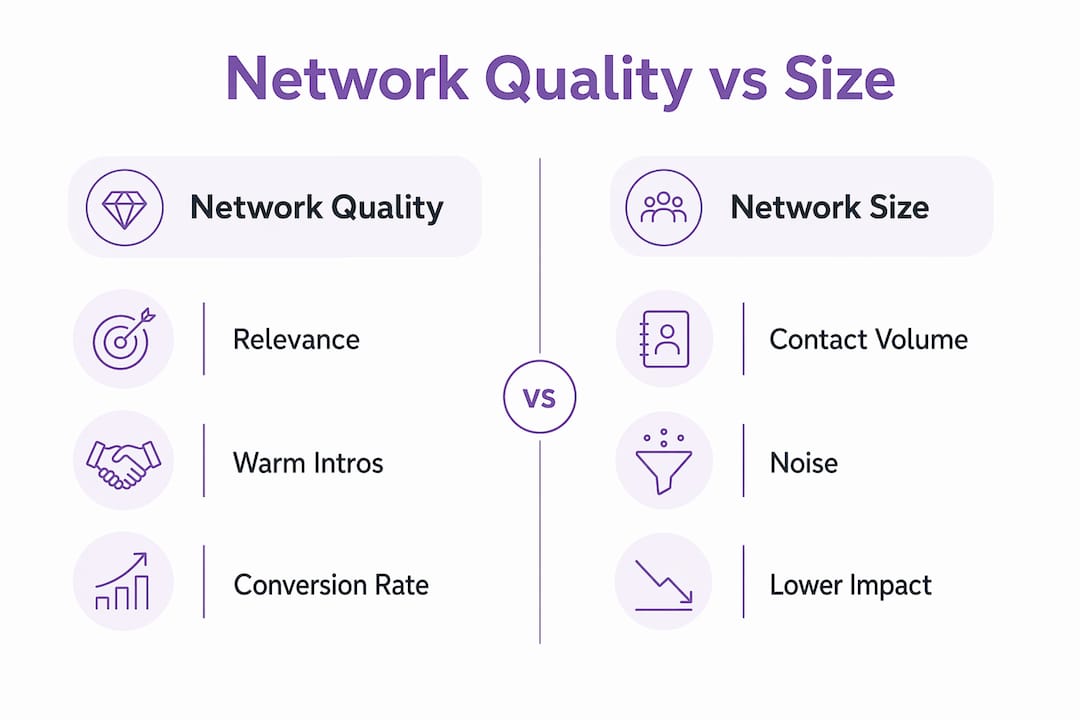
Effective curation techniques include building a critical contacts register of 50–150 decision-makers, segmenting by relationship warmth, and scheduling quarterly reviews to update contact status. The goal is a network you can activate, not one you can count.
How can professionals activate their networks to increase sales?
Network activation is the process of turning dormant contacts into live pipeline. The five-step activation loop covers mapping, categorising, matching asks, timing outreach, and closing the feedback loop. Each step is necessary. Skipping the feedback step, where you tell a connector what happened after their introduction, prevents the network channel from maturing beyond occasional leads.
Here is how to run the loop in practice:
- Map your network. Export your LinkedIn connections and email contacts into a single list. Tag each contact by sector, seniority, and relationship warmth. This takes two to three hours and is the foundation of everything that follows.
- Categorise by ask. Identify which contacts are best placed to introduce you to specific types of prospect. A former colleague at a law firm is a different asset from a client in manufacturing. Match your open pipeline gaps to the right connectors.
- Match asks to context. The best introduction request arrives when the connector has a natural reason to think of you. A product launch, a shared event, or a mutual contact's post creates context that makes the ask feel organic rather than transactional.
- Time your outreach. AI-powered tools save 1.5 hours per seller weekly by handling research and message drafting automatically. Use that time saving to focus on timing and tone, the two variables that AI cannot judge as well as a human who knows the relationship.
- Close the feedback loop. After every introduction, send the connector a brief update on what happened. This single habit doubles response rates over time because connectors learn that their introductions lead to real outcomes.
Building a referral programme around this loop adds a structural incentive layer. Offer connectors something of genuine value, whether access to your own network, a public acknowledgement, or a formal referral fee, and the loop becomes self-reinforcing.
Pro Tip: Set a calendar reminder 72 hours after every introduction to send a one-sentence update to the connector. The habit takes 30 seconds and compounds into a network that actively generates pipeline on your behalf.
The digital contact sharing step matters here too. When a connector makes an introduction at an event, the quality of your first impression determines whether the new contact follows up. A Lynko NFC card that instantly shares your full digital profile, including social links, Google reviews, and a contact-saving option, removes every barrier between a handshake and a saved contact.
Key takeaways
Networking tools boost revenue because warm introductions outperform cold outreach by a factor of 15–25x, and structured activation of a curated, relevant network produces compounding pipeline growth that paid channels cannot replicate.
| Point | Details |
|---|---|
| Warm introductions outperform cold outreach | Response rates of 40–50% versus 2–3% reduce customer acquisition costs significantly. |
| Network quality beats network size | Top-quintile networks for relevance and reach are 1.8x more likely to achieve commercial traction. |
| Hybrid networking drives sustainable growth | Combining face-to-face trust with digital maintenance tools produces more scalable revenue than either alone. |
| The five-step activation loop is non-negotiable | Mapping, categorising, matching, timing, and closing the feedback loop turns dormant contacts into live pipeline. |
| First impressions determine follow-up rates | A digital profile shared instantly at the point of meeting removes the friction that kills post-event relationships. |
Why networking compounds when paid ads plateau
Paid advertising produces results in direct proportion to spend. Switch off the budget and the pipeline dries up. Networking does the opposite. Every relationship you build and every introduction you facilitate adds to a stock of trust that generates returns without further investment. Relationships compound in value unlike any paid channel, and that compounding effect is the real reason networking tools boost revenue over the long term.
What I have observed in 2026 is a clear split between professionals who treat networking as a social activity and those who treat it as a revenue system. The first group attends events, collects cards, and wonders why their pipeline is unpredictable. The second group maps their network, activates it systematically, and closes the feedback loop after every introduction. The difference in outcomes is not marginal.
The buyer behaviour shift reinforces this. Decision-makers are harder to reach through cold channels than at any point in the past decade. Inboxes are filtered, calls are screened, and LinkedIn InMails are ignored unless they come with a warm context. The professionals who have built curated, activated networks are the ones who still get meetings. The rest are competing on price because they cannot get in the room.
My practical advice is to treat your network as a product that requires maintenance. Schedule one hour per week for relationship touches, whether a congratulatory message, a shared article, or a brief catch-up call. The brand identity you project at every touchpoint, digital or physical, determines whether contacts think of you when an opportunity arises. Build the habit before you need the pipeline.
— Olivier
How Lynko fits into a modern networking strategy
The moment a relationship begins is the moment your digital presence either earns trust or loses it. Lynko's NFC business cards let you share a complete, branded digital profile with a single tap to any smartphone, no app required. Your contact sees your social links, Google reviews, and a one-tap save option before you have finished shaking hands.
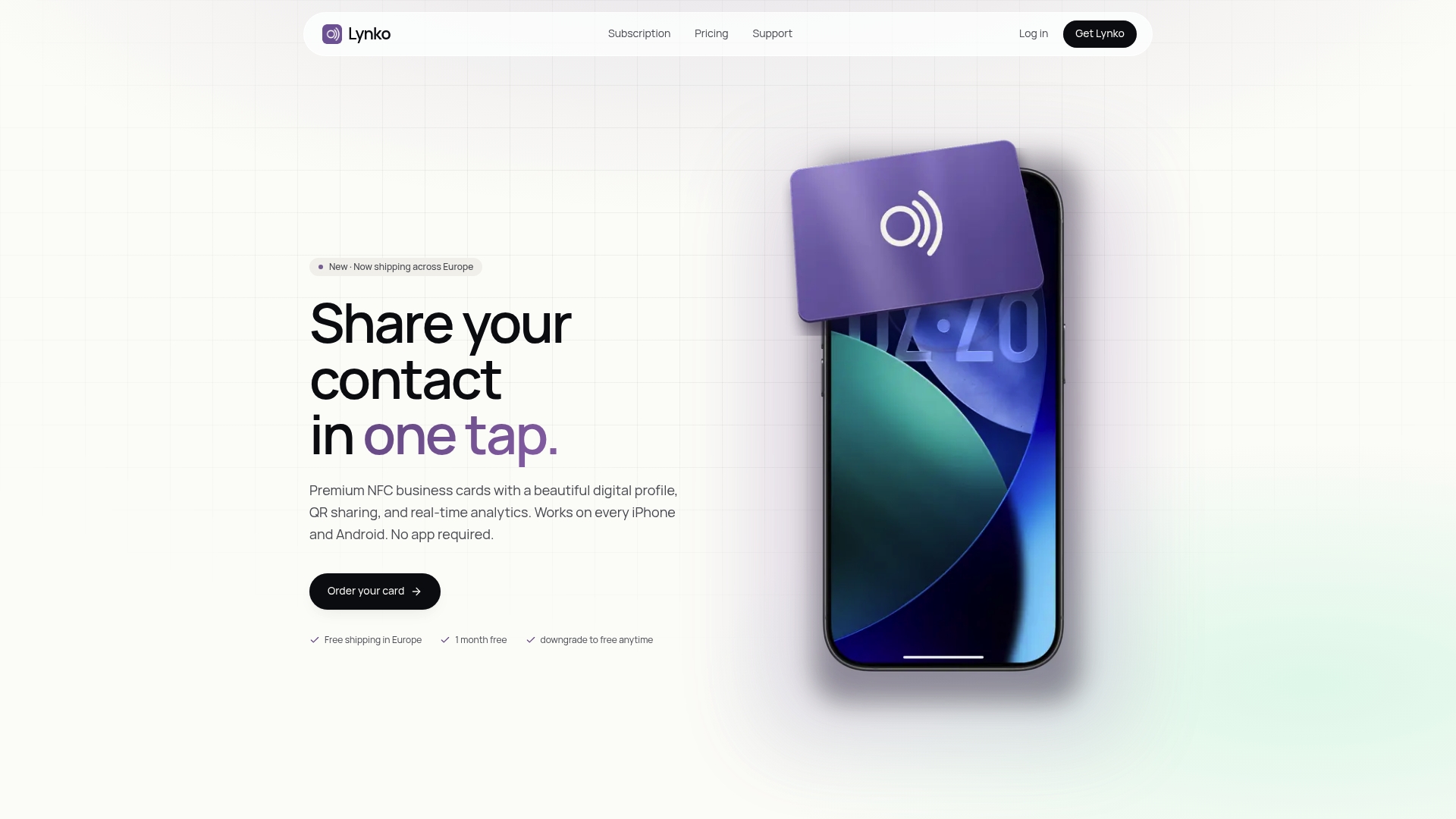
That instant transfer matters because most post-meeting follow-up fails not from lack of intent but from friction. A paper card gets lost. A manually typed email address gets misspelt. A Lynko card removes both problems. The real-time analytics show you who engaged with your profile and when, giving you the context to time your follow-up at the right moment. For professionals running the five-step activation loop, that data turns a social interaction into a trackable pipeline event. Explore Lynko's smart business cards to see how the full profile and NFC features work together.
FAQ
Why do networking tools boost revenue more than cold outreach?
Warm introductions generate 40–50% response rates versus cold outreach's 2–3%. That improvement reduces the number of touchpoints needed to close a deal and lowers customer acquisition costs across the board.
How many meetings can a structured network activation programme generate?
Structured network activation programmes produce 25–50 incremental warm-introduction meetings per quarter for mid-market firms, assuming 60–80% introduction-to-meeting conversion rates.
Does network size or network quality drive more revenue?
Network quality drives more revenue. Research shows that networks in the top quintile for relevance and reach are 1.8 times more likely to achieve commercial traction within 24 months compared to large but uncurated contact lists.
What is the most common mistake in network activation?
Skipping the feedback loop is the most damaging error. Failing to tell connectors what happened after an introduction prevents the network channel from maturing and reduces connector willingness to help again.
How does an NFC business card support a networking revenue strategy?
An NFC business card shares a complete digital profile instantly at the point of meeting, removing the friction between a first conversation and a saved contact, which directly improves post-event follow-up rates.