
One reusable NFC card replaces a stack of paper cards while giving you live analytics, instant profile updates, and a sustainability story worth sharing. For UK professionals, that combination is hard to argue with.
Here is what you get from the switch:
- No reprints. Change your job title, phone number, or LinkedIn URL and your card updates instantly, everywhere.
- Measurable networking. Track who tapped, clicked, or saved your details, turning events into a trackable lead source.
- Lower environmental footprint. Ditching paper cards cuts ink, water, and transport from your professional routine.
Start by ordering a single NFC card, building your profile, and testing it at your next meeting or event.
Table of Contents
- The core benefits of reusable digital cards at a glance
- How digital cards reduce your environmental footprint
- Where reusable digital cards add the most value
- Costs, savings, and a simple ROI check
- GDPR and UK data privacy: what you need to know
- How to set up reusable digital cards quickly: 2026 checklist
- How Lynko delivers these benefits
- Security risks and how to manage them
- Getting your team to actually use them
- Durability and the technology question
- Key takeaways
- The adoption gap nobody talks about
- Try Lynko with a single card and one event
The core benefits of reusable digital cards at a glance
The case for going digital rests on five practical advantages that paper cards simply cannot match.

Instant sharing and cross-device compatibility. A tap shares your full profile to any smartphone without an app. Dynamic QR codes and short links cover the cases where NFC is not available, so no contact is ever lost because of a phone model. Contactless business cards work across iOS and Android without friction.
Real-time updates. Updatability is the operational win: a single edit to your profile propagates immediately, so no one receives stale contact details after a role change or rebrand. There are no reprints, no waste, and no awkward corrections scrawled on a card.
Richer branding. A digital profile holds your headshot, portfolio links, video intro, social handles, and Google reviews in one place. That depth of context is impossible on a 90mm × 55mm rectangle.
Analytics and follow-up tracking. Digital cards increase follow-up rates by giving you engagement data: scans, clicks, and geographic signals that tell you which contacts are warm. Analytics turn a networking event into a measurable funnel rather than a bag of cards you sort through later.
ESG signalling. Switching to reusable cards is a small but visible sustainability action, relevant to UK organisations building ESG credentials.
How digital cards reduce your environmental footprint
Paper business cards carry a surprisingly heavy lifecycle cost. Production requires paper pulp, chemical inks, water, and physical distribution. Most cards are discarded within days of receipt, heading straight to landfill.
Switching to reusable digital cards avoids the paper, ink, and water-intensive production cycle entirely, replacing it with a one-time hardware manufacture and a digital profile that lasts indefinitely.
The environmental case for digital cards is strongest when you factor in reprints. Every job change, phone number update, or rebrand triggers another print run with paper cards. A reusable NFC card sidesteps that cycle completely.
For UK organisations with ESG reporting obligations, the switch also generates a small but documentable reduction in consumable waste. Sustainability messaging from the move can be repurposed in CSR communications or annual reports.
Pro Tip: Log the number of paper cards your team would have printed in a year, multiply by your print cost per unit, and add a line to your ESG report noting the avoided waste. It takes ten minutes and gives your sustainability team a concrete data point.
Where reusable digital cards add the most value
Some situations make the advantages obvious immediately.
- Conference and event networking. Tap to share in under two seconds. No fumbling for cards, no running out mid-event. Analytics show which contacts engaged after the event, so you can prioritise follow-ups.
- Sales and business development. NFC cards reduce manual data entry for recipients and feed directly into CRM workflows via UTM parameters or integration links.
- Client meetings and proposals. Share a profile that includes case studies, a portfolio, or a short video introduction. The context you provide before a follow-up call is far richer than a phone number.
- Remote and hybrid meetings. Drop your profile link into a Zoom chat, Teams message, or calendar invite. The card travels without the physical object.
- Team rollouts. Centralised team templates keep branding consistent across a sales team or department, avoiding the mismatched designs that creep into paper card orders.
Event deployment mini-checklist:
- Update your profile before the event (role, current project, social links).
- Test NFC tap on both iOS and Android the day before.
- Have your QR code as a backup on your phone lock screen.
- Check analytics 24 hours after the event to identify warm leads.
Costs, savings, and a simple ROI check
The cost of a reusable digital card typically covers two elements: the physical NFC card hardware and a platform subscription for profile hosting and analytics. Hardware is a one-time purchase; the subscription recurs monthly or annually.
The savings come from avoided reprints. A standard paper card print run costs roughly £20–£50 per box of 250, and most professionals reprint at least once a year after a role change or contact update. Over 24 months, a single professional might spend £40–£100 on paper cards alone, before accounting for design fees. A reusable digital card with a platform subscription often breaks even within the first year, particularly for anyone who reprints frequently.
The hidden ROI is harder to quantify but arguably more valuable. Analytics-led follow-ups mean you contact warm leads faster, which improves conversion rates. For a sales professional, a single additional closed deal from better follow-up tracking dwarfs the annual subscription cost. Digital card savings compound over time as reprints disappear entirely.
GDPR and UK data privacy: what you need to know
Sharing a digital profile is not the same as storing someone's data. When you tap your card and a recipient views your profile, you are sharing your own contact information. The privacy obligations shift when you collect data from recipients, for example through a contact-capture form embedded in your profile.
Practical privacy checklist:
- Data minimisation. Only include contact fields you genuinely need to share. A profile packed with personal details you rarely use creates unnecessary exposure.
- Consent for collection. If your digital card includes a form that captures a recipient's name or email, you need a lawful basis under UK GDPR, typically consent or legitimate interest.
- Retention policies. Contacts saved from your card interactions should be subject to your organisation's standard data retention schedule.
- Secure profile controls. Use a platform that restricts profile editing to authenticated users and logs changes.
- Analytics lawful basis. Aggregate analytics (scans, clicks) generally fall under legitimate interest for B2B networking. One-to-one tracking of named individuals requires more care.
For UK professionals, document your lawful bases and confirm that your card platform is a registered data processor under UK GDPR before rolling out across a team. Reducing your identity theft risk when sharing contact data digitally is also worth reviewing as part of any rollout.
This article is general information, not legal advice. Confirm your specific compliance position with a qualified data protection professional.
How to set up reusable digital cards quickly: 2026 checklist
Getting from zero to live takes less than a day for most professionals.
- Order your NFC card. Choose a provider with UK fulfilment. One card per person is enough to start.
- Build your profile. Add a headshot, current role, contact details, and two or three key links (LinkedIn, portfolio, booking page). Keep it concise.
- Apply a visual theme. Use your brand colours and a clean, mobile-first layout. Avoid cluttered designs: one clear call to action per profile section.
- Connect your CRM. Link your profile to HubSpot, Salesforce, or your preferred contact management tool via integration or UTM parameters.
- Test across devices. Tap your card against an iPhone and an Android handset before your first event. NFC behaviour varies slightly between iOS and Android, and a quick test prevents embarrassment.
- Run a pilot. Give cards to five people in your team first. Gather feedback on the sharing experience before a full rollout.
- Set a measurement baseline. Note your current follow-up rate and average time-to-contact after events. You need a before figure to show the improvement.
Pro Tip: On iPhones running iOS 14 and above, NFC reading is automatic. On older Android models, users may need to enable NFC in settings. Include a QR fallback on your profile page so no tap ever fails silently.
For 2026 design best practices, prioritise accessibility: sufficient colour contrast, legible font sizes on small screens, and a single prominent save-contact button above the fold.
How Lynko delivers these benefits
Lynko's NFC business cards map directly to the advantages covered above.
| Benefit | Lynko feature |
|---|---|
| Real-time profile updates | Edit your profile instantly via the dashboard; changes reflect on every tap immediately |
| Unlimited social links | Add LinkedIn, Instagram, portfolio, booking links, Google reviews, and more |
| Analytics | Track scans, clicks, and engagement per contact or event |
| CRM integration | Connect to contact management workflows; recipients can save details directly |
| GDPR compliance | UK GDPR-compliant platform with secure profile controls and data processor documentation |
| No app required | Recipients tap and view on any smartphone, iOS or Android, without installing anything |
| Brand customisation | Themes and modules tailored to your brand identity |
Lynko handles the platform side; your team still needs to configure CRM integrations and set internal data retention policies. The smart business card hardware is built for durability, avoiding the short lifespan of paper alternatives.
Security risks and how to manage them
Digital cards introduce a small but real attack surface. A profile URL shared widely can be scraped. An NFC card left unattended could be tapped by anyone.
The practical mitigations are straightforward. Use a platform that lets you disable or redirect your profile instantly if a card is lost. Avoid embedding sensitive information (direct dial to a personal mobile, home address) that you would not print on a paper card. For team rollouts, centralised admin controls mean a leaver's profile can be deactivated the same day they leave. Reviewing an identity protection checklist before sharing contact data widely is a sensible precaution for any professional.
Getting your team to actually use them
The most common adoption failure is not technical. It is behavioural. People revert to paper cards because the new habit feels unfamiliar, or because no one modelled the sharing moment clearly.
Three things accelerate adoption. First, run a short demonstration at a team meeting: tap the card, show the profile, walk through the analytics dashboard. Seeing it live removes the uncertainty. Second, give people a script for the sharing moment: "Tap your phone here and it'll save my details." Simple, confident, no explanation required. Third, share analytics results after the first event. When colleagues see that three of their ten taps turned into booked calls, the habit sticks.
Durability and the technology question
A well-made NFC card lasts years. Metal and reusable card hardware outlasts paper by a significant margin, and the profile behind it can be updated indefinitely. The physical card does not become obsolete when your details change.
The technology obsolescence question is more nuanced. NFC is embedded in every modern smartphone and is not going anywhere. The risk is platform-side: if your card provider shuts down, your profile URL breaks. Choose a provider with a clear track record and, ideally, the ability to export your contact data. That single due-diligence check protects your investment.
Key takeaways
Reusable NFC digital cards deliver measurable networking ROI, cut recurring print costs, and give UK professionals a GDPR-aware, analytics-led alternative to paper.
| Point | Details |
|---|---|
| Updatability is the core win | Real-time profile edits prevent outdated contact details without reprints or wasted spend. |
| Analytics improve follow-up | Scan and click data lets you prioritise warm leads after events, improving conversion. |
| ESG and cost savings compound | Avoided reprints and documented waste reduction support both budget and ESG reporting. |
| GDPR checklist before rollout | Confirm lawful basis, data minimisation, and processor registration before sharing at scale. |
| Lynko covers the key features | Real-time edits, unlimited links, analytics, CRM integration, and GDPR compliance in one platform. |
The adoption gap nobody talks about
The professionals who get the least from digital cards are not the ones who bought the wrong product. They are the ones who set up a profile once and never touched it again.
A digital card is only as good as the profile behind it. A stale headshot, a broken portfolio link, or a bio that still says "Head of Sales" when you are now a director: these undermine the very credibility the card is meant to project. The technology is not the hard part. The discipline of treating your digital profile as a living document is.
The second pitfall is measuring the wrong thing. Counting taps is easy. Counting taps that became meetings, proposals, or clients is what actually tells you whether the investment is working. Set that measurement up before your first event, not after.
Third: do not skip the internal training moment. A five-minute demonstration at a team meeting is worth more than a detailed how-to guide nobody reads.
Try Lynko with a single card and one event
Lynko gives UK professionals a direct route from interest to live NFC card, without a long setup process or a complicated contract. One card, one profile, one tap to share everything a new contact needs: your details, your links, your Google reviews, and a save-contact button that works on any phone.
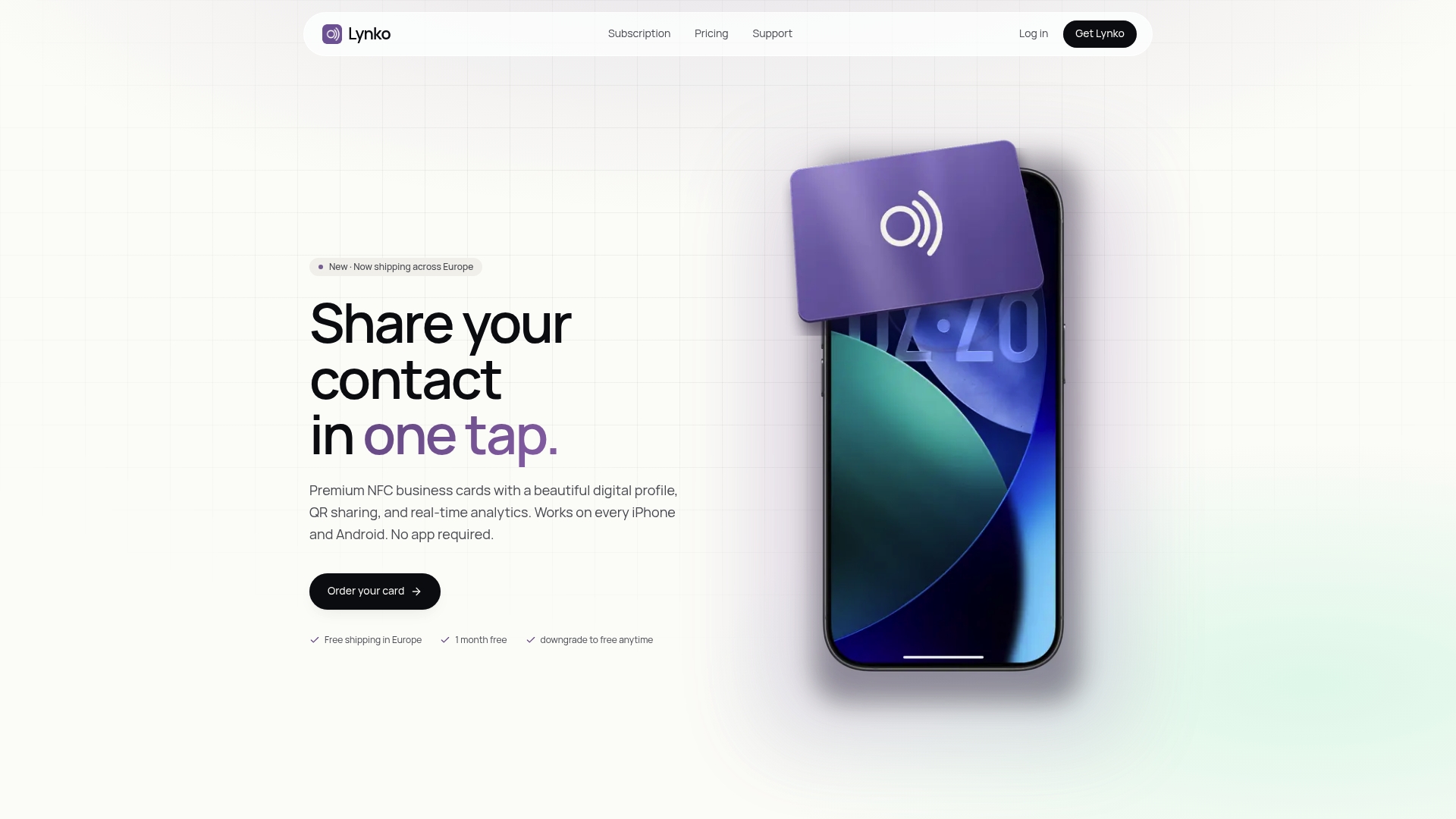
The pricing and GDPR documentation are available on the Lynko website, so you can check both before committing. The lowest-friction way to evaluate it is to order one NFC card, build your profile in under an hour, and test it at your next meeting. If the analytics after that first event do not make the case for you, nothing in this article will.