
Use an investor-focused digital card that links your pitch deck, one-pager, and calendar booking, then share it via NFC tap or QR code at events and follow up based on engagement signals. That is the single most effective action you can take today to move from a handshake to a meeting.
Your investor-ready card needs three things to work:
- Create your card with a deck link, one-pager, investment criteria, and a calendar CTA.
- Share it at the moment of contact: NFC tap, QR scan, or a direct link in a message.
- Follow up within 24–72 hours, prioritising anyone who has clicked through to your materials.
Investor-ready checklist before you share:
- Pitch deck link (PDF or hosted deck, not a raw Google Drive URL)
- One-pager with deal size, geography, and key traction metrics
- Calendar booking link (Calendly or equivalent)
- Contact-save affordance (vCard or Apple/Google Wallet)
- LinkedIn profile link and company website
Table of Contents
- Why digital cards help founders and investors connect
- What to put on an investor-focused digital card
- How sharing and lead capture actually work
- How to create, share, and follow up with an investor-ready card
- Why Lynko is the recommended UK solution
- Best practices to turn a card share into investor interest
- Key takeaways
- Why this approach suits UK founders and real estate investors
- Lynko makes investor networking tangible from day one
- Useful sources
Why digital cards help founders and investors connect
The core reason they work is simple: a digital card is a persistent, mobile-optimised repository for your pitch materials and contact details, and it updates in real time. Change your deck, update your raise amount, swap your calendar link — every investor who has ever scanned your card sees the new version automatically. Paper cards cannot do that.
Friction is where most investor outreach falls apart. A cold email with a PDF attachment gets ignored; a warm tap of a card at an event, followed by a mobile page that opens instantly in a browser without any app download, is a different experience entirely. The investor has your materials in their hand within seconds.
What digital cards fix compared with paper:
- No reprinting when details change
- No manual data entry for the recipient
- Updateable links mean your deck is always the latest version
- Analytics show you who engaged and when
Engagement analytics are where things get genuinely useful. When a card view is followed by a click on your deck link and then a return visit the next morning, that is a meaningful signal. It tells you this investor looked once, thought about it overnight, and came back. That is the person to call first.
Warm introductions are over four times more likely to secure a meeting than cold outreach, according to the UK government's Women-led High Growth Enterprise Taskforce report. A digital card shared through a mutual contact, or handed over at a curated event, sits much closer to that warm end of the spectrum than a cold LinkedIn message ever will.
Stat to remember: Warm introductions are more than four times as likely to result in a meeting as cold outreach. Every share method and follow-up strategy in this article is designed to keep you on the warm side of that line.
What to put on an investor-focused digital card
Most founders put too little on their card or too much. The goal is to give an investor enough to decide whether to take the next step, not to close the deal on the card itself.
Core contact fields:
- Full name, role, and company name
- Email address and phone number
- Calendar booking link (make this prominent)
Investor-specific content:
- Pitch deck link (hosted, not attached)
- One-pager covering deal size, geography, and sector
- Portfolio highlights or recent case studies
- Investment criteria if you are a fund or syndicator
- Key traction metrics (revenue, ARR, units, tenants — whatever is most credible for your stage)
Credibility signals:
- Company logo and a short bio (two sentences maximum)
- LinkedIn profile and press mentions
- Google Reviews if you have them (particularly relevant for real estate operators)
CTAs and saving options:
- "Book a call" button linked to your calendar
- vCard download or Apple/Google Wallet add
- "Request one-pager" link or form
For real estate investors, NFC card use cases for entrepreneurs covers practical scenarios where these fields map directly to investor questions at open houses and property viewings.
Pro Tip: Write your value proposition as a single sentence that answers "what do you do, for whom, and what is the result?" Place it at the top of your mobile profile, above the fold, before any links. On a phone screen, you have about three seconds before someone scrolls or closes the tab.

How sharing and lead capture actually work
Four methods cover almost every situation you will encounter. The right one depends on where you are and who you are talking to.

| Share method | Friction for recipient | Best moment to use | Analytics available |
|---|---|---|---|
| NFC tap | Very low — page opens instantly | In-person events, meetings, open houses | Yes |
| QR code | Low — scan with camera app | Presentations, pitch decks, printed materials | Yes |
| Direct link | None — click to open | Email, LinkedIn DM, WhatsApp | Yes |
| Apple/Google Wallet | Very low — saved to phone | Repeat contacts, follow-up sharing | Limited |
The recipient experience is worth spelling out because it matters for investor perception. When someone taps your Lynko card or scans your QR code, a mobile-optimised web page opens in their browser. No app to download, no account to create. They see your profile, click your deck link, and can save your contact details in one tap. For an investor who has just met ten founders at a pitch event, that frictionless experience stands out.
What analytics typically report: card views, individual link clicks (so you know if they opened the deck versus the one-pager), time on page, and return visits. These map directly to investor interest levels. A view with no clicks is curiosity. A view, a deck click, and a return visit the next day is a warm lead.
For CRM tracking, keep it lightweight. Tools like Notion or Airtable work well for early-stage founders. Track: who scanned, where you met them, what they clicked, and your agreed next step. That is enough to run a disciplined follow-up process without a full sales CRM.
The contact-saving functionality is explained in detail in Lynko's guide on client-saving digital cards, which covers how recipients save details directly to their phone contacts.
How to create, share, and follow up with an investor-ready card
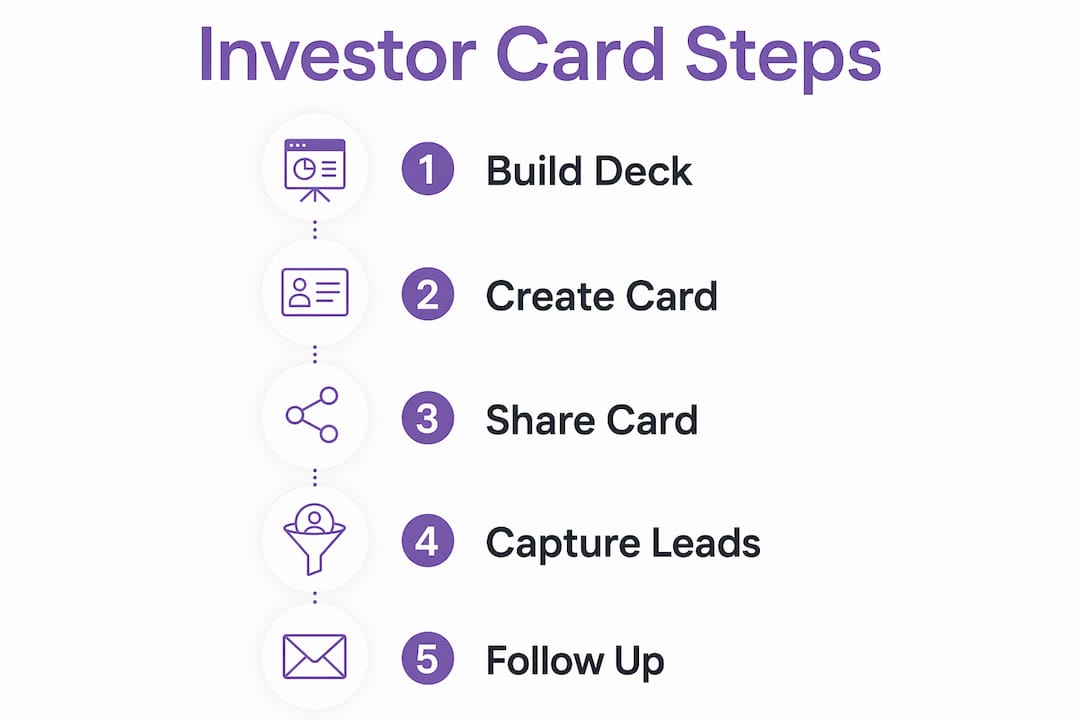
You can go from zero to a shareable investor card in one sitting. Here is the sequence:
- Prepare your assets (30–60 minutes): Host your pitch deck on Docsend, Google Drive, or Notion. Write a one-pager as a PDF. Set up a Calendly link with 30-minute slots labelled "Investor call." Gather your LinkedIn URL, company website, and any press links.
- Build your card (15–30 minutes): Create your Lynko profile, add all fields, embed your deck and one-pager links, set your calendar CTA as the primary button, and upload your logo.
- Test before you share (10 minutes): Open your card on a different phone. Click every link. Book a test meeting through your calendar. Check the mobile layout looks clean above the fold.
- Deploy your share methods: Order your NFC card, download your QR code, and copy your direct link into your email signature and LinkedIn bio.
- Monitor and follow up: Check analytics daily during active fundraising. Follow up within 24–72 hours of a meaningful engagement signal (deck click, return visit). For contacts with no engagement signal, a structured follow-up at 48 hours is a reasonable default.
Pre-share checklist:
- All links open correctly on mobile
- Calendar booking completes without errors
- Profile loads in under three seconds on a mobile connection
- vCard download saves correctly to phone contacts
- Deck is the latest version
For scaling follow-up beyond manual outreach, LeadPilot offers AI-assisted outreach automation that can convert initial engagement into warm replies when used carefully with personalised messaging.
For founders sharing work samples and decks via NFC, the guide on sharing work samples via NFC tap covers file formats and hosting options that keep load times fast.
Why Lynko is the recommended UK solution
Lynko provides tap-to-share NFC cards and mobile-optimised profiles that match the investor-focused workflow described above, with GDPR compliance built in and no app required for recipients.
Feature summary relevant to investor networking:
- NFC tap sharing and QR code generation
- Mobile web profile with modular sections (deck embed, one-pager, calendar link, Google Reviews)
- Real-time analytics: views, link clicks, return visits
- Contact saving via vCard and Apple/Google Wallet
- CRM export and sync options
- Customisable themes and branding modules
- GDPR-compliant data handling for UK founders
GDPR matters here more than it might seem. When an investor saves your contact details or you capture their information through a card interaction, you are handling personal data under UK GDPR. Lynko's compliance posture means the platform handles data in a way that is consistent with UK data protection obligations, which is a genuine consideration when choosing a platform for investor outreach rather than an afterthought.
Pricing follows a card hardware plus profile subscription model. Setup time from account creation to a shareable card is typically under an hour for a founder who has their assets ready. For real estate investors specifically, Lynko's modules support open house use cases and property portfolio highlights alongside the standard founder pitch workflow. The guide on NFC for realtor networking covers property-specific configurations in detail.
Venture capitalists increasingly use LinkedIn to find and evaluate founders, which is exactly why your Lynko profile should link prominently to an optimised LinkedIn page. The card is the handshake; LinkedIn is the due diligence.
Setup reality check: Most founders who have their deck and one-pager ready can build and test a complete Lynko investor card in under 90 minutes. The NFC card ships separately; the digital profile is shareable via QR and direct link from day one.
Best practices to turn a card share into investor interest
Treat the initial share as a soft invitation, not a pitch. The card opens the door; your follow-up determines whether you walk through it.
Core principles:
- Wait for a meaningful engagement signal before sending detailed financials or a hard ask.
- Use analytics to rank your follow-up list: deck openers first, view-only contacts second.
- Favour warm introductions wherever possible. The four-times multiplier on meeting conversion from the UK government's taskforce report is the clearest argument for investing in your network before your outreach volume.
- Link your card to a LinkedIn profile that shows traction updates and credibility signals, not just a static bio.
Follow-up message templates:
After an event scan:
After a direct link share (no prior meeting):
Event follow-up workflow:
- Export card analytics within 24 hours of the event.
- Segment contacts: engaged (clicked deck or calendar) vs. viewed only.
- Send personalised follow-ups to engaged contacts first, referencing something specific from your conversation.
- For view-only contacts, a lighter touch at 48–72 hours: a brief note with a direct link to your one-pager.
For real estate investors attending open houses, the guide on digital tools for open house networking covers event-specific workflows and how to segment attendee follow-up by interest level.
A strong digital presence amplifies everything above. Content and website signals — including SEIS/EIS information for UK businesses — make it easier for investors to evaluate you between your card share and your follow-up call. The card gets them to your profile; your profile gets them to the call.
Stat: Warm introductions are over four times more likely to result in a meeting than cold outreach. Prioritise any card share that comes through a mutual connection or a curated event over cold digital outreach.
Key takeaways
A digital investor card works because it combines persistent pitch materials, real-time analytics, and frictionless sharing into a single tap, giving founders a structured way to move from first contact to booked meeting.
| Point | Details |
|---|---|
| Build before you go | Have your deck, one-pager, and calendar link ready before creating your card — the card is only as good as what it links to. |
| Analytics drive follow-up | Prioritise contacts who clicked your deck or returned to your profile; they are your warmest leads. |
| Warm intros outperform cold | Warm introductions are over four times more likely to secure a meeting; use your card to reinforce warm connections, not replace them. |
| GDPR compliance matters | Choose a platform with UK GDPR-compliant data handling — Lynko is built with this in mind for UK founders. |
| Lynko as your starting point | Create a Lynko NFC card and digital profile, test it on mobile, and share via QR or direct link from day one while your physical card ships. |
Why this approach suits UK founders and real estate investors
The workflow described in this article fits the UK market for a specific reason: British investors, whether angel networks, VCs, or property syndicators, tend to do their homework before a meeting rather than during one. They will look at your LinkedIn, check your website, and read your one-pager in their own time. A digital card that puts all of that in one tap respects that behaviour rather than fighting it.
What I find underestimated is the GDPR angle. UK founders often treat data compliance as a legal box to tick, but investors notice it. A card platform that handles contact data correctly signals that you run a tight operation. That is a credibility signal before you have said a word about your business.
For the first 90 days, watch three things: your card view-to-click rate (are people opening your deck?), your click-to-meeting rate (are deck openers booking calls?), and your follow-up response rate by channel (event scan vs. direct link vs. warm intro). Those three numbers will tell you exactly where your investor outreach is working and where it is leaking.
Lynko makes investor networking tangible from day one
Founders who want to connect with investors using digital cards without building a custom tech stack have a direct route: Lynko's NFC business cards paired with a modular digital profile give you tap-to-share hardware, a mobile-optimised investor page, real-time analytics, and GDPR-compliant contact saving in one product.
The setup takes under 90 minutes if your assets are ready. Your digital profile is shareable via QR code and direct link from the moment you create it, so you do not need to wait for the physical card to arrive before your next pitch event. Pricing follows a card plus subscription model, with options suited to individual founders and small teams.
Order your NFC business card and have a shareable investor profile live before your next event.
Useful sources
- Women-led High Growth Enterprise Taskforce report (UK Government) — the source for the warm introduction conversion data cited throughout this article; worth reading in full for UK fundraising context.
- Digital business card UK — Lynko — Lynko's product page covering sharing methods, mobile profile features, and setup steps for UK founders.
- NFC card use cases for entrepreneurs — Lynko blog — practical scenarios for NFC sharing across different networking contexts.
- How to get your startup in front of investors — Startupik — covers CRM tools and tracking approaches for early-stage outreach.
- VCs are finding startups on LinkedIn — Inc. — explains how investors use LinkedIn to evaluate founders; relevant for optimising the profile your card links to.
- How to attract investors with digital marketing — ProfileTree — covers website and content signals that support investor credibility, including SEIS/EIS for UK businesses.
- Digital tools for open house networking — Lynko blog — event-specific workflows for real estate investors using digital cards.
- LeadPilot — outreach automation — AI-assisted follow-up tool for scaling personalised investor outreach from digital card engagement.