
How NFC transforms the way you share your portfolio
The role of NFC in portfolio sharing is straightforward: a passive chip embedded in a card stores a URL, and a single tap from any NFC-enabled smartphone opens your portfolio instantly. No app download. No typing. No fumbling with a QR code scanner.
That URL can point anywhere: a curated project showcase, a booking calendar, a LinkedIn profile, or a landing page built specifically for warm leads. And when your portfolio changes, you update the destination online. The physical card stays the same.
Core functions at a glance:
- Instant access: recipients tap the card and land on your portfolio within seconds
- App-free reading: NFC tags work via passive electromagnetic induction, requiring nothing from the recipient's phone beyond NFC support
- Live content: update your portfolio, rates, or availability without reprinting
- Multi-destination linking: point to portfolios, social profiles, booking tools, or Google reviews
- Reprogrammable: redirect the card to a new URL whenever your focus shifts
Table of Contents
- How NFC technology actually works for sharing
- Why NFC gives your portfolio sharing a real edge
- How to implement NFC portfolio sharing with Lynko in the UK
- GDPR compliance when using NFC for portfolio sharing in the UK
- Lynko makes NFC portfolio sharing work from day one
- Key takeaways
How NFC technology actually works for sharing
NFC operates via electromagnetic induction at a range of roughly 4 cm or less. The chip in your card is passive, meaning it draws power from the reader's field rather than a battery. When a smartphone comes close, it energises the chip, reads the stored data, and acts on it — typically by opening a browser.
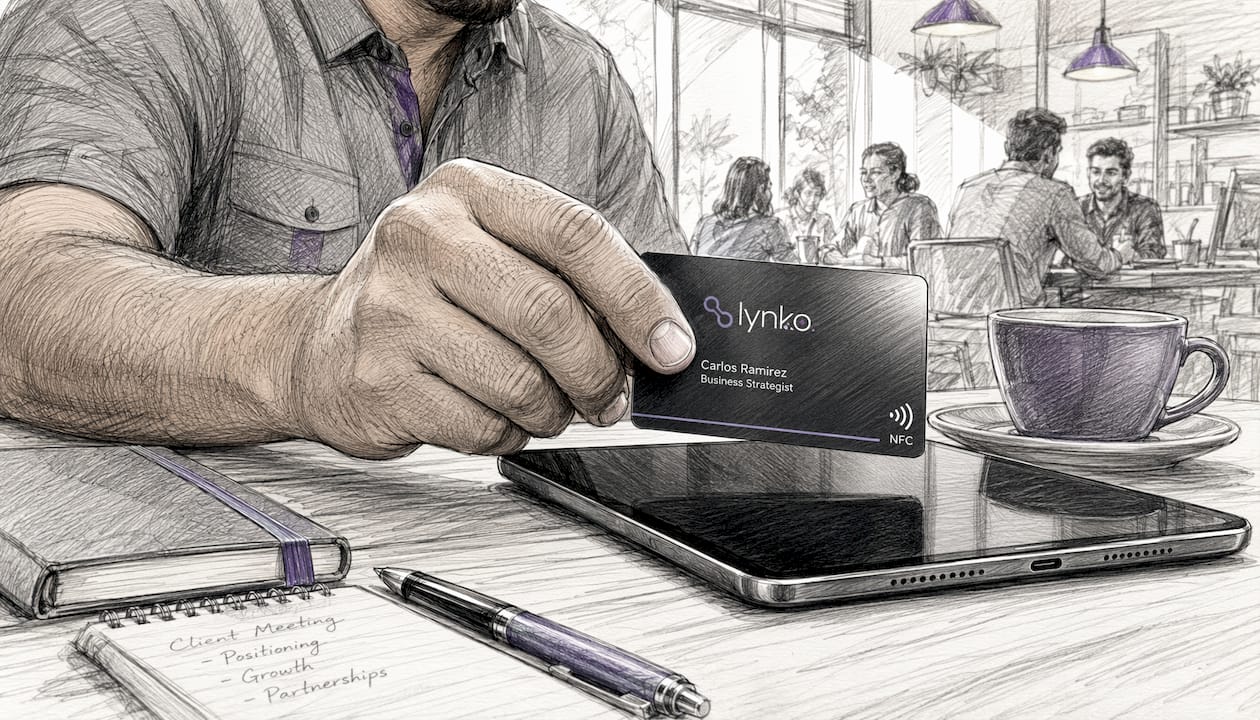
What the chip stores is minimal by design. NFC data rates max out at 424 kbps, which is more than sufficient for a URL but not for transferring files directly. That constraint is actually a feature: the chip holds a lightweight pointer, and all the rich content lives on your hosted portfolio page.
Key technical points:
- Proximity required: activation needs physical closeness, which reduces accidental triggers
- No pairing: unlike Bluetooth, NFC requires no handshake or device pairing
- Chip capacity: NFC chips store small payloads — URLs sit well within their limits
- Rewritable storage: the URL on most NFC cards can be overwritten using a standard NFC writing app
| Technical aspect | Detail |
|---|---|
| Communication range | Under 4 cm |
| Data type stored | URLs, text strings |
| Power source | Passive (reader-powered) |
| App needed by recipient | None |
| Reprogrammable | Yes, via NFC writing apps |
Why NFC gives your portfolio sharing a real edge
Printed cards go in pockets and get forgotten. QR codes require a camera app, good lighting, and a steady hand. NFC removes all of that friction. One tap, and the person you just met is looking at your work.
The intent-to-action gap is where most networking leads die. Someone is genuinely interested, but by the time they get home and search for you manually, the moment has passed. NFC closes that gap at the point of interest, not hours later.
Benefits for professionals and creatives:
- Reduced drop-off: no typing errors, no failed searches, no lost leads
- Real-time portfolio updates: change your featured work or rates without touching the card
- Mobile-first experience: recipients land on a page built for the device in their hand
- Analytics visibility: track who tapped, when, and from where
- Multi-platform reach: one card can surface your Instagram, Behance, Calendly, or any combination
- Professional impression: a tap feels considered and modern in a way a paper card simply does not
Creatives in particular benefit from NFC-enabled sharing because their work is inherently visual. Sending someone to a live portfolio beats describing your style in conversation every time.
How to implement NFC portfolio sharing with Lynko in the UK
Lynko's NFC business cards are built specifically for this workflow. The setup takes minutes, and the result is a card that functions as a live gateway to your professional identity.
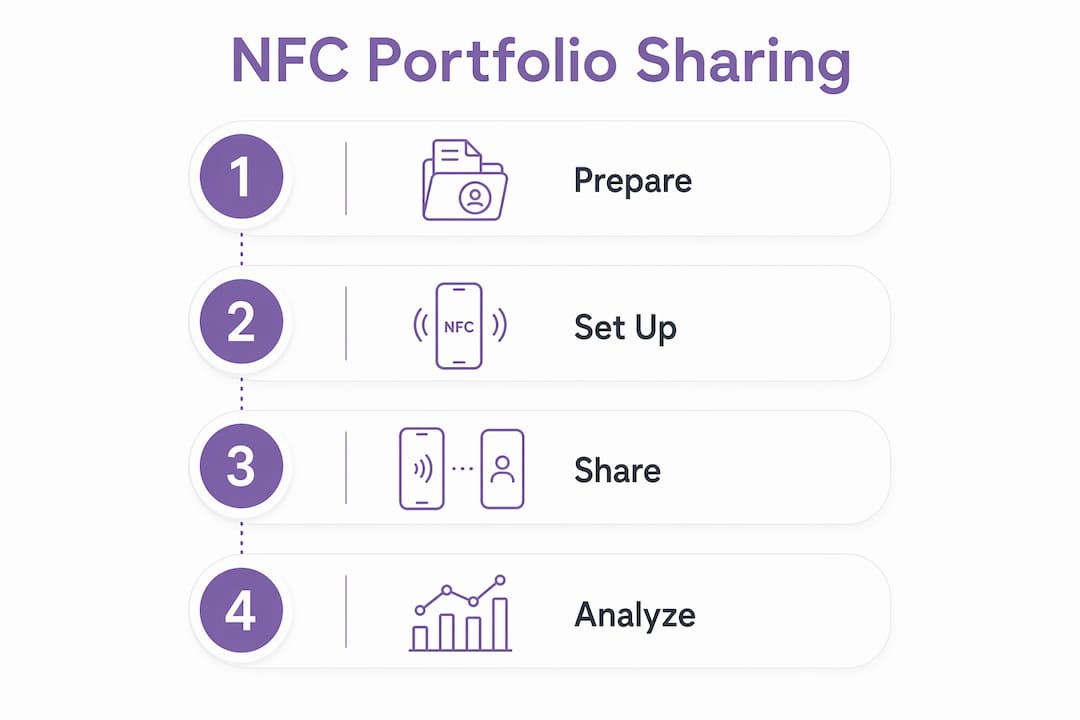
Step 1: Prepare your destination. Before programming anything, decide where the card points. A dedicated landing page outperforms a generic homepage. Successful professionals tend to land visitors on targeted pages: a booking calendar, a curated case study selection, or a showcase built for a specific client type. Keep it mobile-optimised — a slow or cluttered page wastes the tap.
Step 2: Set up your Lynko profile. Lynko's digital profiles support unlimited social links, Google reviews integration, and contact-saving functionality. You can configure themes and modules to match your personal brand rather than working from a blank template.
Step 3: Share at the right moment. At events, meetings, or pitches, offer the card when interest is highest. The tap takes under two seconds. Follow up the same day while the interaction is fresh — NFC analytics show you exactly who engaged and when.
| Lynko feature | Benefit for portfolio sharing |
|---|---|
| Real-time analytics | See tap activity and engagement patterns |
| GDPR compliance | Handle UK data obligations without extra tools |
| Unlimited social links | Surface every relevant platform from one tap |
| Google reviews integration | Build credibility alongside your portfolio |
| Reprogrammable card | Update destinations without ordering new cards |
| Custom themes and modules | Present a profile that matches your brand |
Pro Tip: Point your card to a mobile-optimised landing page rather than your full website. A focused page with one clear action converts far better than a homepage with ten options.
Implementation checklist:
- Choose and optimise your portfolio destination URL
- Configure your Lynko digital profile with relevant links and branding
- Programme the card URL using Lynko's setup process
- Test the tap on both Android and iOS before using the card publicly
- Review analytics after each networking event and adjust your destination if engagement drops
For a broader view of how NFC fits into professional networking, the practical NFC networking guide covers additional use cases worth exploring.
GDPR compliance when using NFC for portfolio sharing in the UK
NFC cards themselves do not collect data — the chip simply redirects. The compliance questions arise from what happens after the tap: analytics tools, contact forms, and cookies on your portfolio page all fall under UK GDPR.
UK data protection law requires transparency about what you collect, a lawful basis for processing, and secure handling of any personal information. If your portfolio page uses Google Analytics or captures form submissions, visitors need to know.
Lynko is built with GDPR compliance in mind, which removes a significant burden for UK professionals who would otherwise need to audit third-party tools independently.
Compliance steps to follow:
- Cookie consent: display a clear consent banner on any analytics-enabled portfolio page
- Privacy notice: link to a privacy policy that explains what data is collected and why
- Data minimisation: collect only what you genuinely need from contact forms
- Secure hosting: ensure your portfolio platform uses HTTPS and stores data securely
- Recipient rights: provide a straightforward way for contacts to request data deletion
Cold outreach and digital networking strategies carry similar obligations — the medium changes, but the transparency requirement does not.
Lynko makes NFC portfolio sharing work from day one
Most professionals know they should have a shareable digital portfolio. The gap is usually the friction between knowing and doing. Lynko removes that friction entirely: one card, one tap, and whoever you hand it to sees exactly what you want them to see, on a profile you control in real time.
Unlike generic NFC solutions, Lynko's cards come with built-in analytics, GDPR-compliant infrastructure, and customisable profiles designed for UK professionals and creatives. There is no app for recipients to download, no subscription lock-in for basic functionality, and no reprinting when your portfolio evolves.
If you are ready to replace the paper card with something that actually works, Lynko's NFC business cards are available for UK professionals now.
Key takeaways
NFC portfolio sharing works because it stores a URL on a passive chip, delivers instant app-free access to live content, and gives professionals full control over what recipients see after a single tap.
| Point | Details |
|---|---|
| How NFC sharing works | A passive chip stores a URL; any NFC smartphone reads it without an app or pairing. |
| Reprogrammable cards | Update your portfolio destination at any time without replacing the physical card. |
| GDPR obligations | Analytics and forms on your portfolio page require consent banners and a clear privacy notice under UK law. |
| Mobile optimisation matters | A slow or cluttered destination page wastes the tap — build for mobile first. |
| Lynko for UK professionals | Lynko's NFC cards include real-time analytics, GDPR compliance, and unlimited social links out of the box. |